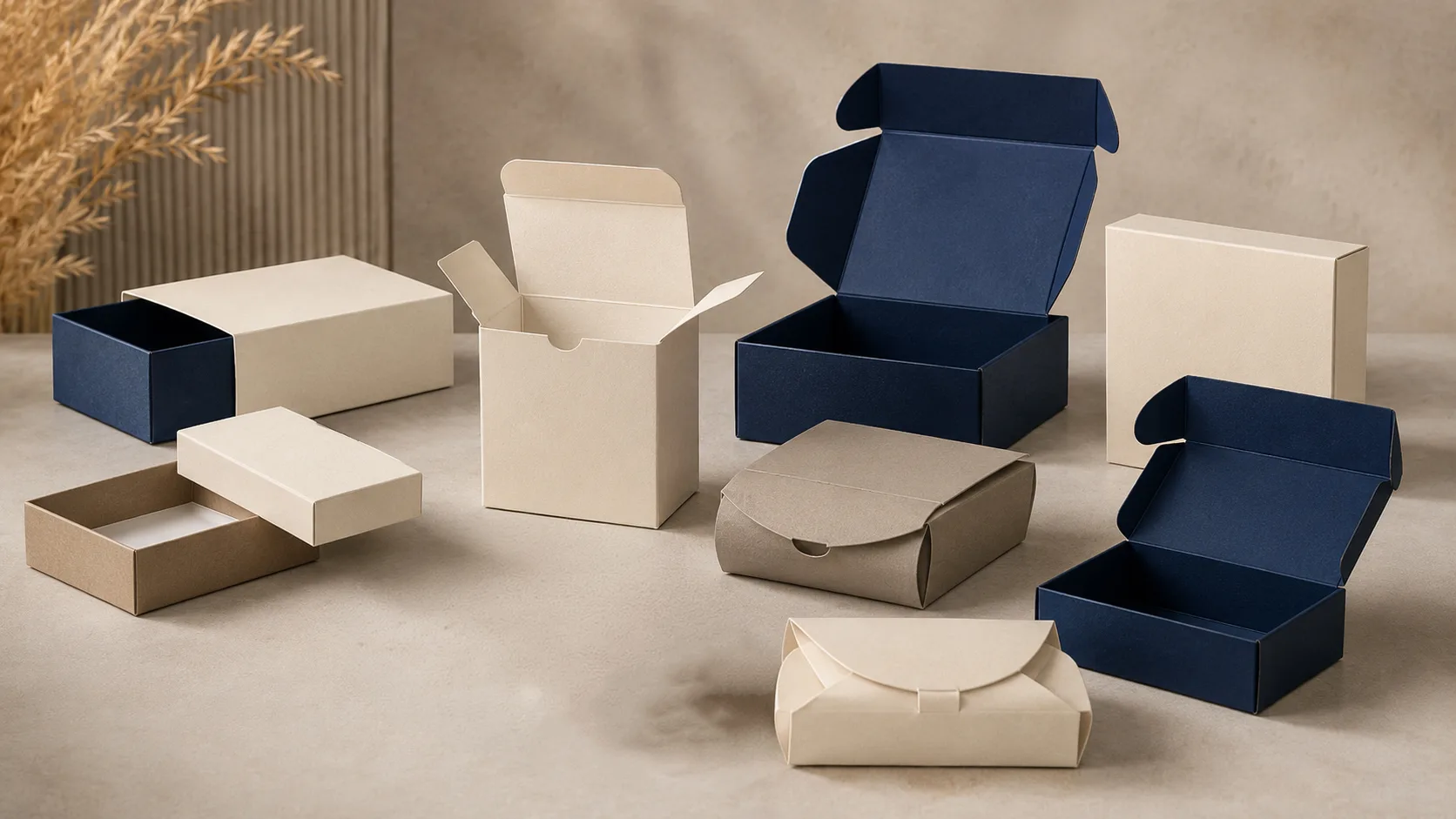
Folding Carton
Folding cartons are die-cut from art card or kraft board and ship flat, making them significantly more cost-effective than rigid boxes. Ideal for higher volumes and products that need efficient storage and shipping.
Folding cartons — the cost-controlled option
A folding carton is a paper box die-cut flat to a template and shipped flat, then folded up at the point of use. It is the lowest cost-per-unit paper packaging we produce, and the right answer for volume work.
The usual stock is 300–400 gsm art card, printable across the full surface, with kraft paper available where a more natural tone is wanted.
How it differs from a rigid box
This is the question we field most often, and the honest answer is that they are different jobs.
- Cost — a folding carton is clearly cheaper per box: less forming, less board.
- Freight and storage — it ships and stacks flat, saving both shipping cost and stockroom space, unlike a rigid box that arrives already formed and takes up volume.
- Hand feel — a rigid box is noticeably more solid and reads more premium. A folding carton is thinner and has more flex.
If packaging cost per unit still has to be controlled, the folding carton is the answer. If the product is a gift or a high-value item, move up to rigid.
Shapes it can take
Because it is formed by die-cutting to a steel die, the shape is very flexible: standard tuck-end cartons, auto-bottom boxes, carry-handle boxes, product windows, or custom outlines to your artwork.
It still takes matte coating or spot UV and foil stamping like any other box, so a folding carton does not have to look cheap.
What it suits
Best for high-volume retail goods — smaller cosmetic boxes, supplement boxes, pharmaceutical cartons, snack boxes, and anything going into modern trade.
Flexible MOQ. There is no fixed site-wide minimum — small campaigns can start in the dozens and scale to 50,000+ piece orders, with 10–15 day production and a real mock-up to approve before every run.